
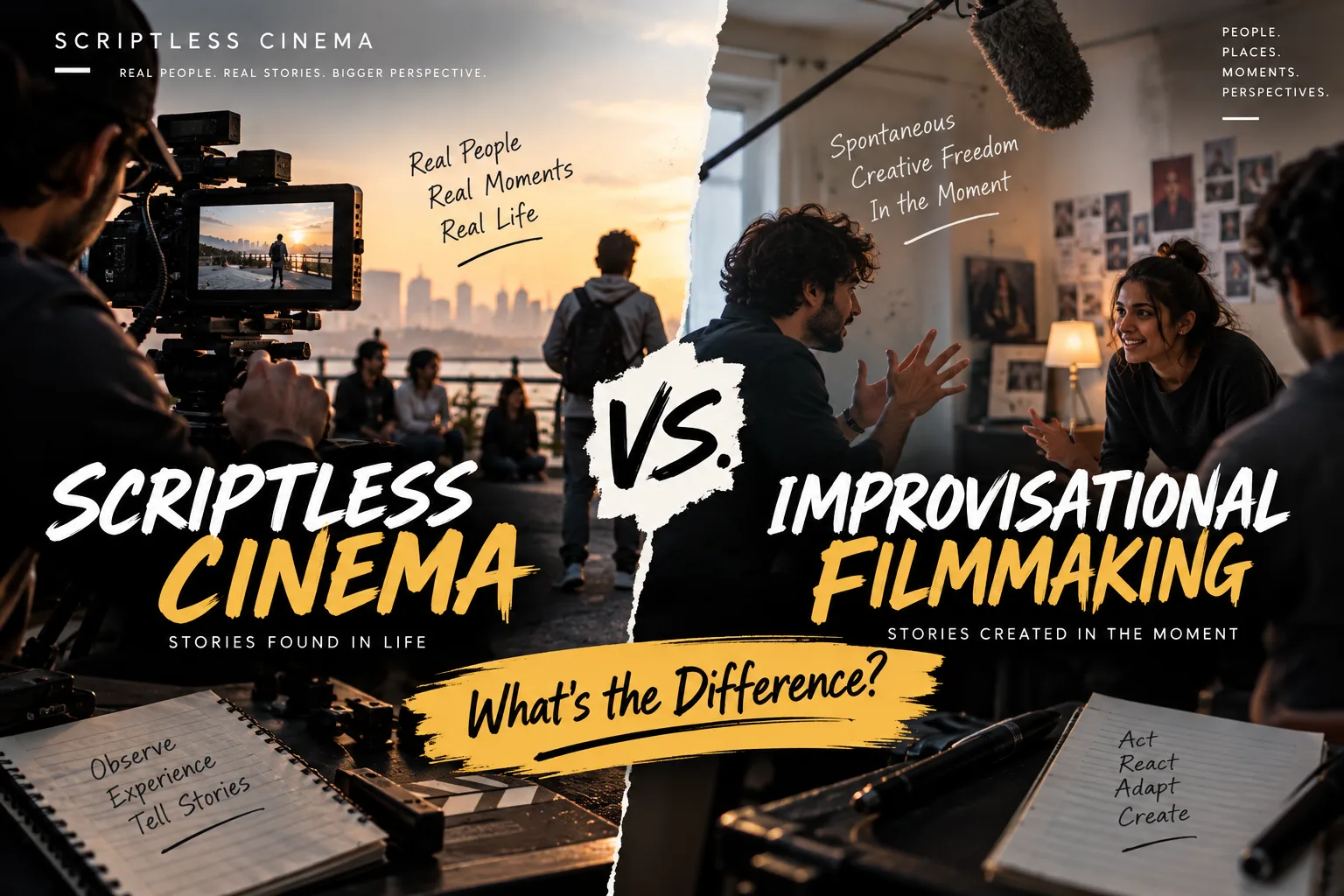
At first glance, Scriptless Cinema and improvisational filmmaking can look like the same thing wearing two different names. Both involve actors speaking without memorized dialogue. Both trust the camera to capture something that wasn’t written down in advance. Both resist the idea that a film’s truth can be fully predicted before the cameras roll. It’s an easy conflation to make, and one worth untangling carefully, because the difference between the two isn’t a matter of degree — it’s a difference in what each method is actually built to do.
Improvisational filmmaking, in its most common form, is a performance technique. Actors are given a scenario — sometimes detailed, sometimes little more than a one-line setup — and asked to generate dialogue and behavior spontaneously, in the moment, often drawing on comedic or dramatic instinct honed through improv training. The tradition runs deep, from rehearsal-built dramas to the loose, talky ensembles of mumblecore to the games-based exercises actors learn in improv theater. What unites these approaches is that the spontaneity is often the point. The unpredictability is the product being sold to the audience — the sense that anything could happen, that the actors are genuinely inventing as they go.
Scriptless Cinema shares the absence of a locked screenplay, but it is not built around spontaneity as an end in itself. It is a method for authorship without prediction — a way of writing a film’s story after it has been lived through, rather than before. The analogy that grounds the whole approach comes not from theater but from engineering: in manufacturing, an “as-planned” drawing is an estimate, a prediction made before anything physical exists. The “as-built” drawing, recorded after construction is complete, is treated as the authoritative record — because it reflects what actually happened, not what someone guessed would happen. A conventional screenplay is an as-planned document. Scriptless Cinema treats the finished film as an as-built one. That distinction — treating the process as an act of discovery and documentation rather than performance and invention — is what separates the two methods, even when they look identical from the outside on any given day of shooting.
Where the Two Methods Genuinely Overlap
It would be dishonest to pretend there’s no overlap, because there is real kinship here. Both methods reject the idea that dialogue must be memorized to be authentic. Both ask actors to listen and react rather than recite. Both create space for something unplanned to happen on camera and be kept rather than cut. Anyone watching raw footage from an improv-heavy production and a Scriptless Cinema production on the same day might struggle to tell them apart — actors talking, reacting, building a scene moment to moment, no visible script in anyone’s hand.
The overlap is real enough that Scriptless Cinema could reasonably be described as a subset of improvisational filmmaking broadly defined — but not the other way around. Not all improvisational filmmaking is Scriptless Cinema, and understanding why clarifies what actually makes the method distinct.
Where They Diverge: Preparation
The first real divergence is in what happens before the camera turns on. General improvisational filmmaking can range from heavily rehearsed to genuinely loose and unplanned (a scenario handed to actors minutes before filming). Scriptless Cinema sits at a specific, more structured point on that spectrum: premise, characters, objectives, and scene stakes are always established in advance. What is withheld is narrower and more deliberate — it is specifically the dialogue and the exact beats, not the underlying architecture of who these people are and what they each want.
Consider how this played out in the making of Dil-o-Dimaag, a 14-scene Hindi-language drama built around self-love, marital dysfunction, and redemption. The scenes existed as a defined dramatic structure — this many scenes, this arc, these characters, this theme — before filming began. What wasn’t fixed was the specific language each character would use to get there. That’s a very different starting point from an improv troupe walking onto a set with a single suggested scenario and building everything, structure included, from nothing.
Where They Diverge: The Role of the Unplanned Event
In general improv filmmaking, an unplanned moment — an actor breaking character, a line that doesn’t land, a genuine flub — is often either the comedic payoff itself or something to be filtered out in editing if it doesn’t serve the scene. It’s treated as a byproduct of the performance technique, evaluated after the fact for whether it was funny, moving, or usable.
In Scriptless Cinema, the unplanned event carries a different status. It isn’t a byproduct — it’s the primary material the method exists to capture. This is visible in the making of Ek Tarfa, an early short film centered on a woman dissuaded from suicide by her uncle, who then transforms herself before her former lover returns to beg for her back. During filming, an unplanned wardrobe and appearance choice — the actress had already styled herself with reading glasses, giving her a classy, elegant look before a scene that was originally meant to show her pre-transformation — became something the production simply kept rather than corrected. Instead of reshooting to match a planned continuity, the unexpected choice was folded into the character’s arc, and she became not only more polished in appearance but visibly working harder toward the successful, self-possessed version of herself the story needed. Nothing about that moment was scripted, and nothing about it was treated as an error to fix. That’s the operational difference: in Scriptless Cinema, the unplanned is presumed usable until it actively contradicts the premise, not presumed disposable until it happens to be funny or dramatic enough to keep.
Where They Diverge: Editing
Both methods lean on the edit to shape a final film, but they lean on it differently. In much improvisational filmmaking, editing functions as a search for the best version of a scene among many competing takes and directions — the editor is choosing the funniest read, the most dramatically effective version, the cut that plays best. That’s a curatorial role.
In Scriptless Cinema, editing does something closer to authorship. Since the exact dialogue and specific dramatic turns were never fixed in advance, the edit is frequently where the story’s actual final shape gets written — closer to how an as-built drawing gets compiled from what a construction crew actually did, not from what a set of blueprints predicted. This is why Scriptless Cinema productions sometimes maintain two parallel documents: a working script that stays roughly aligned with the story’s intent, and what amounts to an “as-built” record of what was actually shot, reconciled together in the edit. That reconciliation process — checking a written script against footage that was captured in a genuinely different order, in different locations than planned, shaped by whatever a specific weekend’s shooting schedule allowed — is a level of editorial authorship that general improvisational filmmaking, with its more curatorial approach to editing, doesn’t typically require.
Where They Diverge: Director and Actor Roles
In improvisational filmmaking, the director’s job during a scene is often to referee — to keep the scenario moving, nudge performers back on track if the improv drifts too far afield, and call the take when something usable has emerged. The actor’s job is largely one of comedic or dramatic invention in real time, drawing on trained instinct.
In Scriptless Cinema, the director’s preparatory work is heavier and happens earlier. Before the camera rolls, the director has already defined the scene’s stakes and each character’s objective — who wants what from whom, and why it matters. Communication with actors during the shoot tends to be objective-based rather than line-based: a note like “she needs to get him to admit it” rather than a corrected line reading. The actor’s job, correspondingly, is less about spontaneous invention and more about sustained character truth — knowing the character well enough that whatever they say in the moment, however unplanned, remains recognizably and consistently them. That’s a subtly different skill from comedic improv quick-thinking, closer to the kind of deep character prep an actor might do for a heavily scripted dramatic role, minus the memorized lines.
Is All Improv Scriptless Cinema? Is All Scriptless Cinema Improv?
To answer the comparison directly: no, and no — but asymmetrically. All Scriptless Cinema productions involve a degree of improvisation, since dialogue is generated live rather than recited. But not all improvisational filmmaking follows the Scriptless Cinema method, because plenty of improv-based productions skip the premise-first, objective-driven preparation that defines it, or treat editing as curation rather than authorship, or treat the director’s role as referee rather than architect.
| Improvisational Filmmaking (general) | Scriptless Cinema |
|---|---|
| Pre-production | Ranges from minimal to heavily rehearsed |
| Pre-production | Always: premise, characters, objectives fixed |
| Dialogue | Generated live |
| Dialogue | Generated live |
| Unplanned events | Kept if they work; often filtered out |
| Unplanned events | Presumed usable; treated as primary material |
| Editing role | Curatorial — choosing the best take |
| Editing role | Authorial — constructing the “as-built” story |
| Director’s role | Referee, keeps scenario on track |
| Director’s role | Architect of stakes and objectives beforehand |
| Actor’s job | Comedic/dramatic quick invention |
| Actor’s job | Sustained character truth without memorized lines |
Why the Distinction Matters
This isn’t a semantic argument for its own sake. Filmmakers considering an unscripted approach need to know which discipline they’re actually adopting, because the two demand different preparation and produce different kinds of films. A production built for spontaneous comedic invention will falter if it tries to bolt on Scriptless Cinema’s heavier premise-and-objective architecture midway through. Equally, a Scriptless Cinema production that skips its own preparatory groundwork — that shows up without defined character objectives and just tells actors to “improvise” — isn’t practicing the method; it’s practicing plain improv filmmaking under a borrowed name.
The clearest way to hold the distinction: improvisational filmmaking is a performance technique built around spontaneity as its own value. Scriptless Cinema is an authorship method built around treating the as-built record of what actually happened — captured live, shaped in the edit — as more truthful than any script written in advance. Both trust the moment. Only one is structured to write the film from it.